

Radicals, rebels and social innovators have long congregated in London's eastern boroughs. What they did – and how they did it – are perhaps of as much relevance to society today as they have ever been.
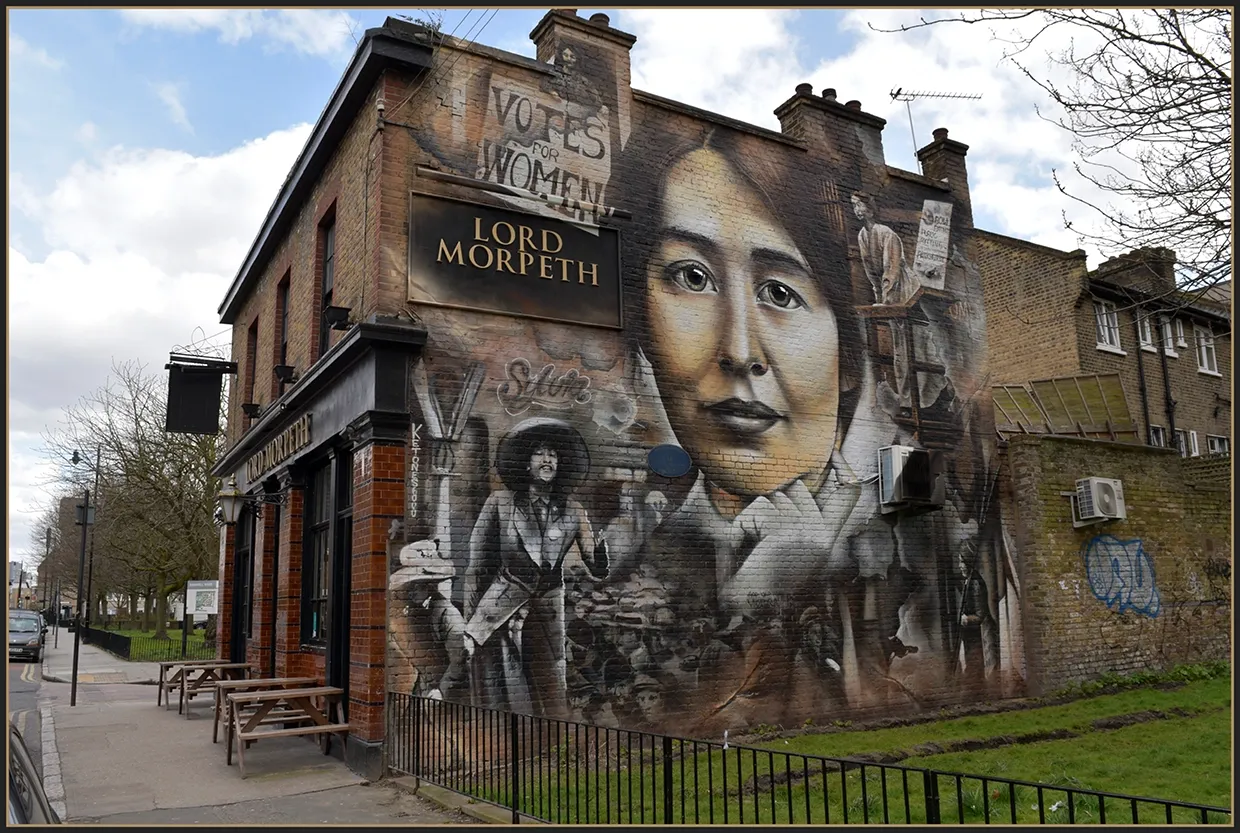
Among the best-known of Britain's 20th century activists is artist-turned-activist Sylvia Pankhurst. In 1913, the suffragette drew together the Bow, Bromley, Stepney, Limehouse, Bethnal Green and Poplar branches of the Women’s Social and Political Union (WSPU) together to form a new movement that in 1914 was formally named the East London Federation of the Suffragettes (ELFS). The group championed women’s suffrage rights, placing particular emphasis on the rights of working women.
With the Women’s Hall at 400 Old Ford Road as their base, they publicised their cause via public meetings, rallies in Victoria Park, marches and fundraising events, as well as via their very own newspaper, The Woman’s Dreadnought.
The backstory to this move was the decision in 1912 by MP for Bow and Bromley and supporter of the WSPU, George Lansbury, to resign his seat to fight a by-election campaigning in favour of votes for women – something his own Labour Party was at that time not supporting. This led to a dilemma for the Women’s Social and Political Union, which was run by Sylvia’s mother, Emmeline and her sister, Christabel. They wanted to further the local cause, but refused to work alongside men.
While stubbornness prevailed, Grace Roe – who would go on to become Head of Suffragette operations for the WSPU – supported Lansbury in the by-election, which he ultimately lost by 752 votes. This defeat prompted the WSPU to pull out of east London altogether. Sylvia wasn’t having this, so she broke from her mother and sister's leadership to set up her own organisation. The ELFS operated in the East End, in one guise or another, for the next decade.
From this a new kind of social movement was built. Though the context has evolved hugely in the intervening years, many of the challenges these local women faced in the 1910s will resonate with people today, who are grappling with rising living costs, radically right-wing politics and restraints on the ability to protest.
One of the things that made the ELFS visionary was the mini welfare state the group put together after the First World War broke out. War meant factory closures, inflation and hard times for many, especially the east Londoners already living in straitened circumstances.
The women of the ELFS rose to this challenge, setting up advice centres, distributing milk to children, running a health clinic and opening low-cost canteens. One project included the creation of a toy factory which paid a living wage and boasted one of the UK’s first creches – hardly revolutionary as we enter 2026, but unheard of a century ago.
For those with their finger on the current political pulse, the protest activities of Sylvia and her fellow activists may still be of interest. They were militant to the core and no strangers to the use of brutal tactics, such as breaking windows and burning down the homes of the rich.
Sylvia had a bodyguard called ‘Kosher Bill’, a local Jewish boxer, whose job it was to keep her safe from police interest. Even so, she was nevertheless arrested on multiple occasions and served several stints in Holloway Prison, where she went on hunger strike and was, on numerous occasions, force-fed. Between 1913 and 1914, she was arrested eight times for protest actions in London.
The history books look back on the suffragettes with awe and admiration – they got women the vote in 1918, after all. But what about the means they used to do so? Much more modest forms of protest are still getting people thrown into jail these days. Has fighting for rights changed that much in the past century? It may take a new wave of East End radicals to give us the answer.


