

“I'll be with a thousand strangers on a platform, and that feeling of connection is a big deal for me. The private space and the public space, connected by these entrails [...] that makes me feel part of the city”. This is what has drawn Jock McFadyen to paint the London Underground. Now, a collection of his recent pictures is to be paired with sound art by Jem Finer (formerly of the Pogues) in an exhibition at the Guildhall Art Gallery entitled Underground (and Surface).
McFadyen took me on a tour of the show as it was being hung. In the first room, we ramble round the Tube stations of London, surrounded by Finer’s bewitching audio work from field recordings made on the Northern and Central lines. You strain to place what you hear, even if eerily familiar: the screeching of wheel on rail, doors whooshing shut, the shuffling of bodies that you hardly pay attention to as a passenger, but which become amazingly present listening to them in a gallery.
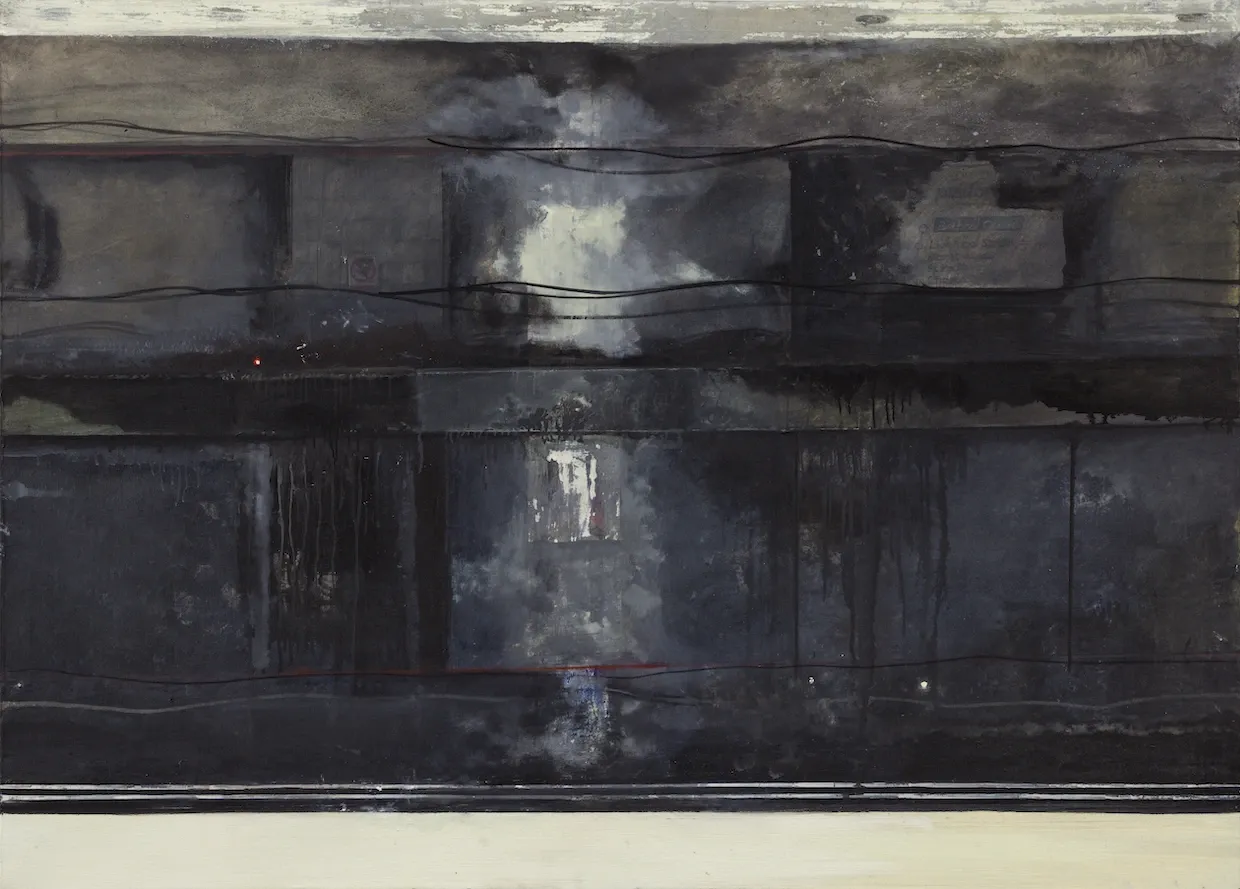
“My hope would be that the paintings and the soundscape each give something, another sense, to each other”, Finer says. “I was very influenced by not just the paintings and their locations, but by the painting itself, the textures and techniques, the brush strokes and abstraction”.
The influence was mutual. McFadyen was initially taken with the particular noise of the trains running from Liverpool Street to Bethnal Green, which is what prompted him to bring Finer into the joint project.
Bathed in these otherworldly sounds, we look round at the Royal Academician’s depictions of long vistas and close-up details that make up our daily commute.
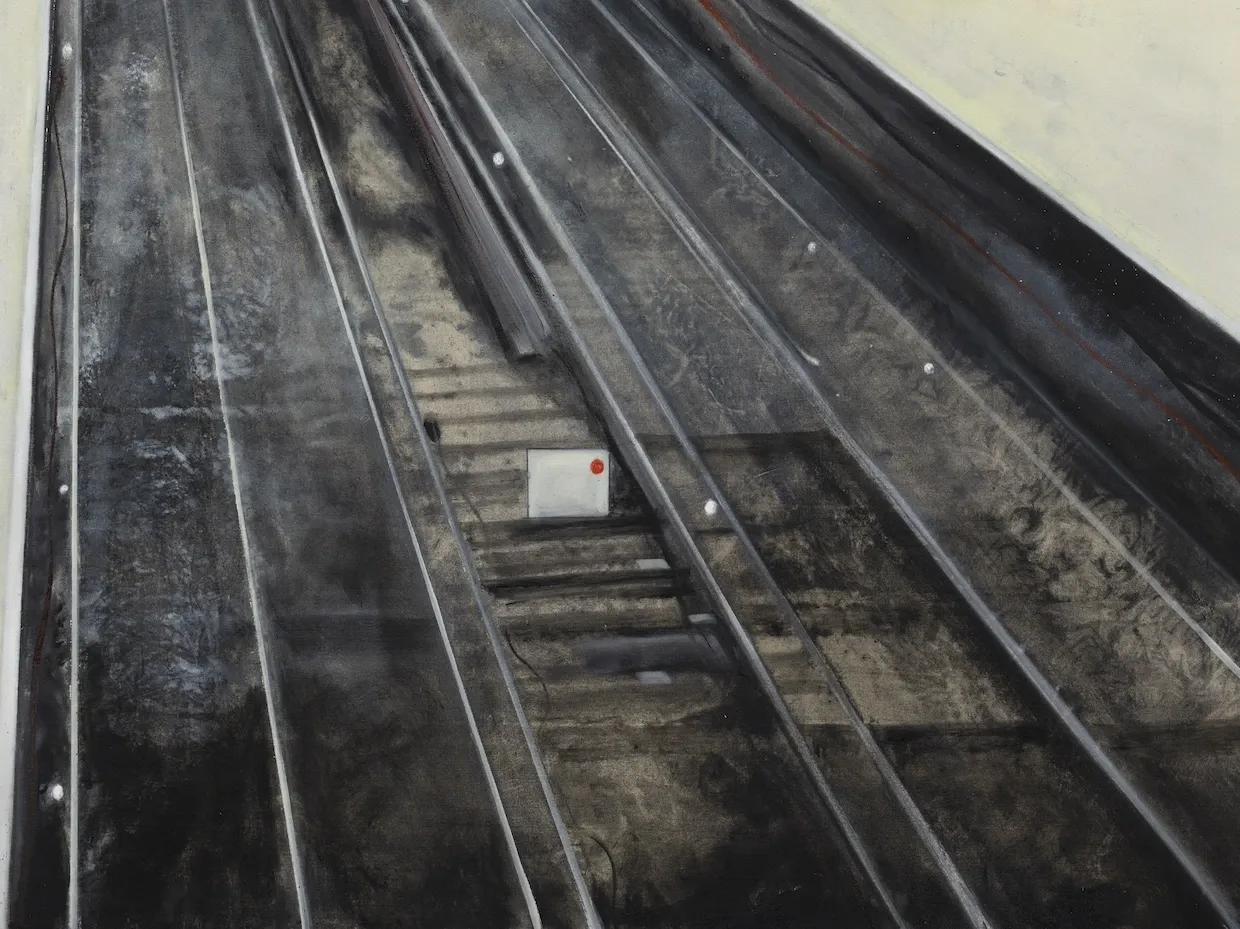
Passing the brightly-hued triptych of Bank before sidling up to the more muted tones of Aldgate East, McFadyen talks about his work. From squatting on the King’s Road in the 1970s (“If you're going to squat, get a good address”), he moved to Bethnal Green, not far from his studio-gallery in London Fields. And it is for his landscapes of the eastern reaches of London that he is perhaps best known.
We surface in the adjacent room to McFadyen’s trademark above-ground pieces, and I spot Olympia, showing a shiny new block of flats looming over lush vegetation. He recounts how he snuck into the Olympic Park in 2011 with writer Iain Sinclair, who had borrowed an inflatable canoe, to photograph what was going on in the runup to the Games. After their visit, a series of yellow floats were installed to prevent further incursions, but McFadyen used the trip down the waterway as the basis of several paintings of ‘regeneration’ against traditional East London backdrops.
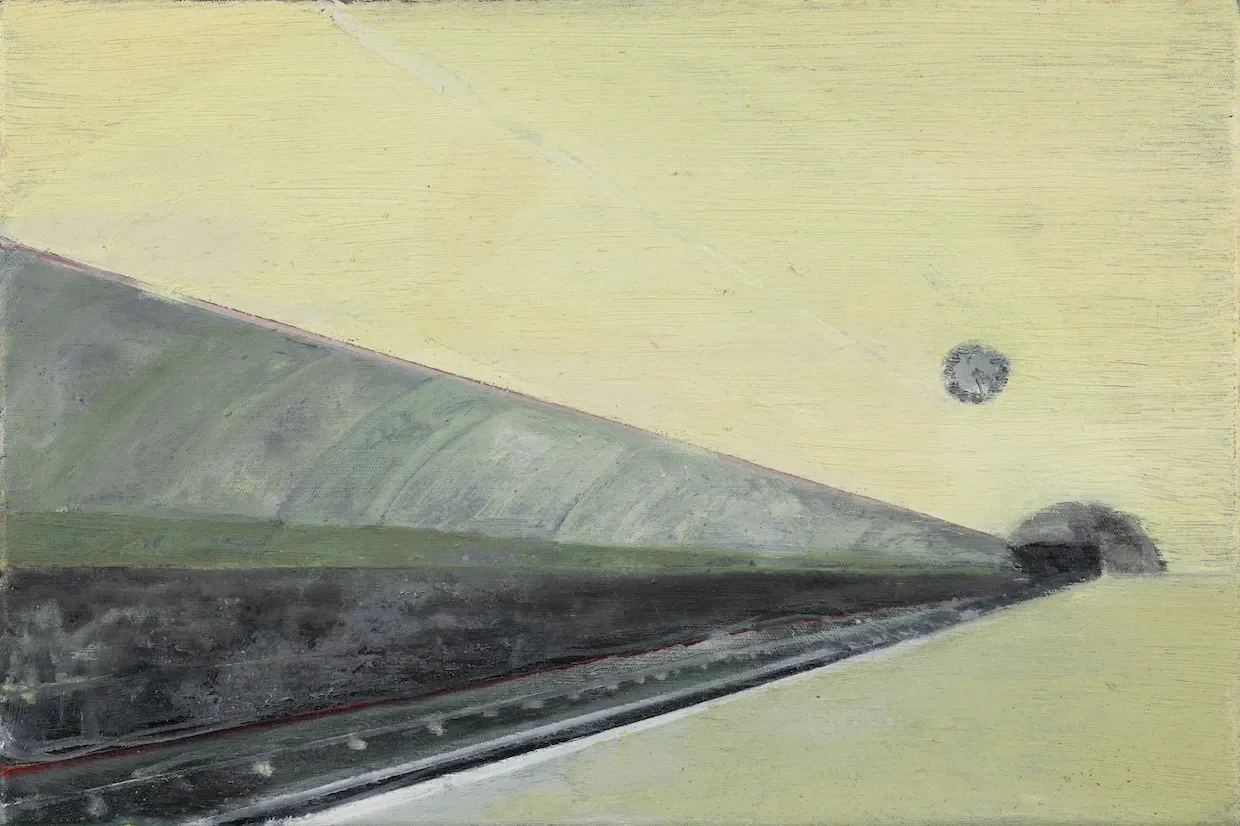
If his fans know him as an artist who can make our local slime sublime, it was a while before he focused on the gritty spaces with which his work is associated. His earlier career had included more figures, but when he was commissioned to design a ballet set, there were no people to include.
He tells me how this changed what he did: “When I went back after working with Royal Ballet, I threw away my crutches and started making pictures of places. And of course, my studio was in the East End and the first one I did was Mare Street Snooker Centre. That was the first picture I did without any figures in it (except is does have the wee green man on the crossing sign)”.
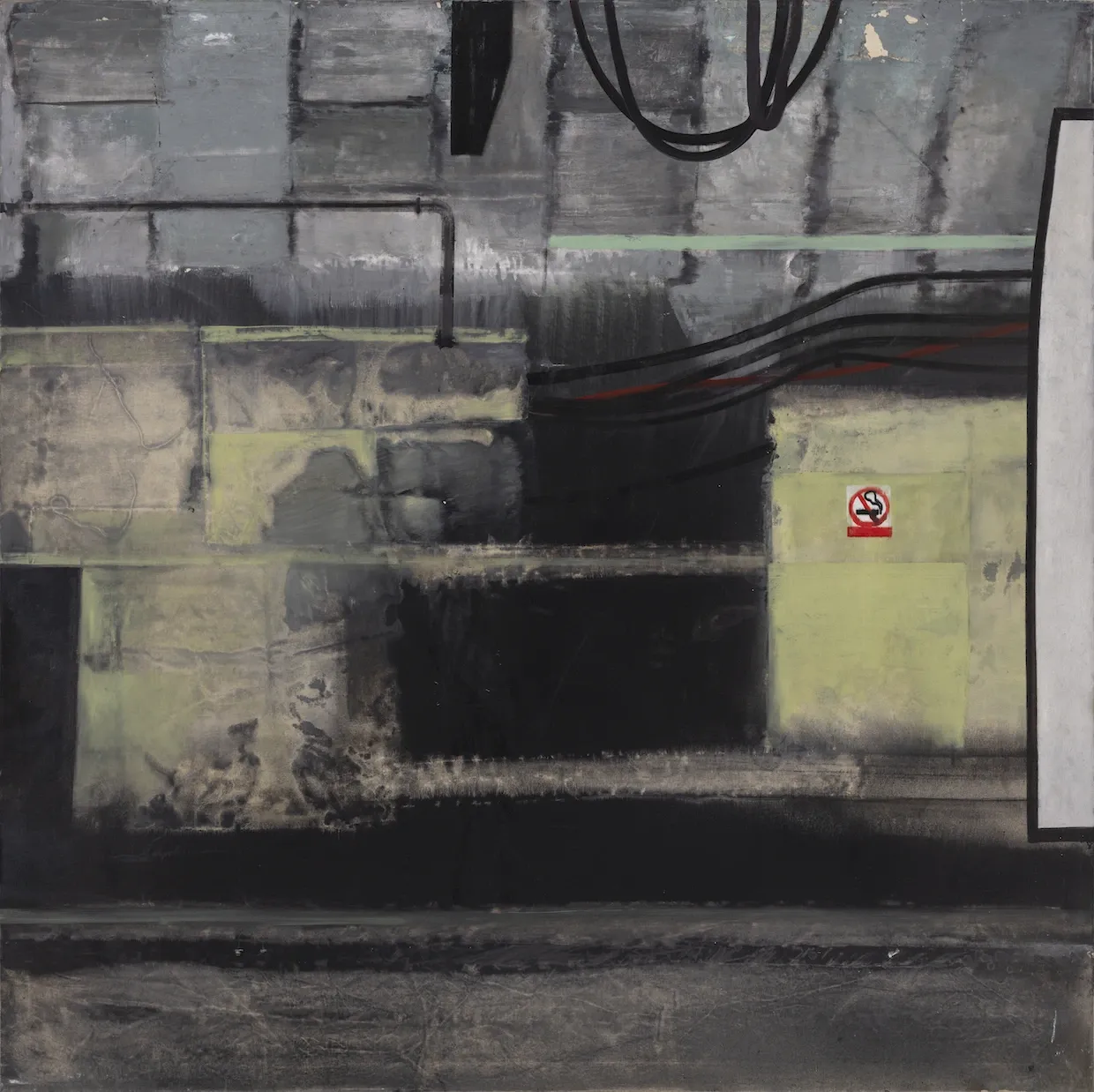
The electric green crossing sign is emblematic of McFadyen cityscapes – streetlights, squares of lit windows, the glow of a Homebase that lights up the sky like a sunset. He is fascinated with the technical role that artificial light now plays in art.
“Paintings have a different light now, because of the possibility of electric lights. A lot of people don't realise that most paintings are done indoors. It's the paint that makes the light, so it doesn't really matter”.
Most enchanting perhaps are McFadyen’s large canvasses of big skies and dilapidated structures. Folding technology into nature is something for which J. M. W. Turner is known, and McFadyen admits that gets his skies counterpointed by small objects from the nineteenth-century master. “That's what gives the vastness its power”, he explains. “It's actually, I suppose, finding meaning in the landscape”.
Jock McFadyen with Jem Finer: Underground (and Surface). Guildhall Art Gallery, Guildhall Yard, EC2V 5AE. 27 February – 20 September. Book here.


