

This May, an earthen installation by Colombian artist Delcy Morelos will transform the Barbican’s Sculpture Court, and its organic remains may make a return to Hackney’s own soil.
Marking the first time in a decade the court has been used for its original purpose, Origo is an immersive project that asks visitors to re-evaluate their connection to the earth. While the site has hosted multimedia works in recent years, a dedicated large-scale sculpture hasn’t inhabited the space since the 1980s.
Assistant Curator Diego Chocano’s choice of Morelos to "break the silence" was driven by a desire to create contrast with the Barbican’s brutalism. This project marks the third in a series of public commissions designed to examine the relation of different media to the structure of the centre.
“The underlying ethos across all of these commissions is to invite artists who have a very material practice because we want to have an interesting dialogue with the cement monolith that is the Barbican”, says Chocano. “Delcy focuses very much on one material: soil. It is both the subject and matter of her artwork”.
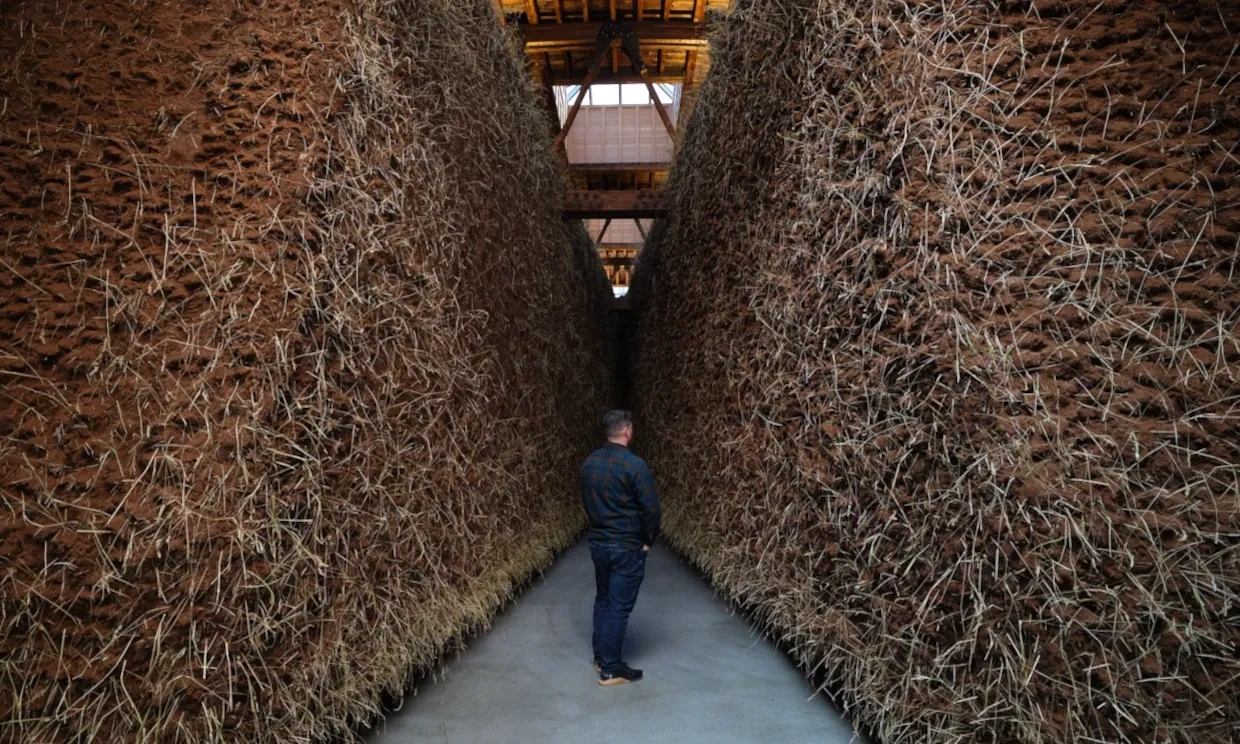
The project was developed at the crux of the site’s rich history and future focus. “Another amazing thing about the Barbican is that the texture that you get on the surfaces was all drilled by hand when it was being built”, Chocano explains. “And so we also want to work with artists who have haptic practices, where the trace of human touch is very much felt”.
The choice of artist also speaks to the site’s history as a wasteland following the Blitz. “From the ashes of that, this utopic living project came out of it”, Chocano notes. “Delcy felt like a no-brainer insofar as her work at the very beginning was thinking about how the effects of violence between humans, the effects that that has on land”.
Morelos’ work centres on a kind of Andean cosmovision. “Through her work, I hope people will become attuned to the porosity of the human body”, says Chocano. “What we breathe in is often what someone else is breathing out”.
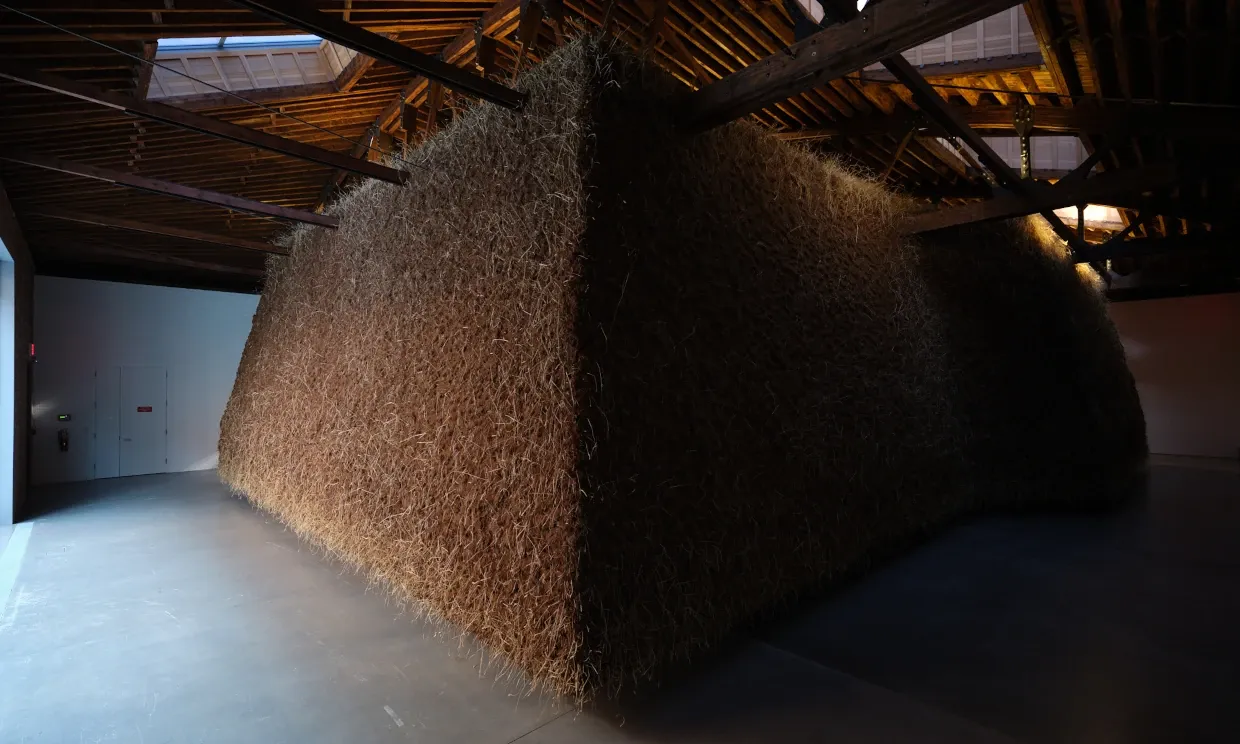
The sculpture’s ovular form is inspired by shabonos, which are circular Amazonian dwellings used by the Yanomami people. “Every family can see into the other’s module, and then the center is a place to gather”, Chocano says. “The artwork has this completely empty center where we're hoping that people will be able to convene with each other, but also with the earth”.
For Morelos, the creation of the exhibition went beyond the visual—the soil used in the sculpture is infused with cinnamon and cloves. “Smell triggers memory, and soil for Delcy is a very nostalgic material as well”, Chocano explains.
Morelos told him of her childhood in the Colombian Caribbean during a meeting in Bilbao. “One of her earliest memories is having to dampen her hands every morning and massage these circles on the soil floor to dampen the soil so that dust didn't kick up in the house all day”.
Building a massive organic structure in the middle of a residential estate presented a two-year technical challenge. Sustainability remains a priority, and once the installation closes, its wooden substructure will be reused. As for the tonnes of soil, the Barbican team is currently finalising rehousing plans.
“The soil will not go to waste”, Chocano hints. “Perhaps it will even end up in some of Hackney’s local gardens”. For those looking to escape the traffic-filled streets this spring, the free sculpture court offers a sort of meditative retreat.
“Hackney, as well as several other boroughs in London, are obviously so bustling and so full of people that we hope that it's going to be like a place of respite”, Chocano concludes. “Delcy's mission is to create these spaces where you can feel the power of the soil as a mother material”.
Origo
15 May - 31 July 2026
Free entry
Barbican Sculpture Court
Barbican
Silk Street
EC2Y 8DS


