

Youth unemployment is sky high, inflation is spiking and far right activists are calling for immigrants to ‘go back’ to where they came from. Does this sound like the latest news report?
In the 1970s it was also the backdrop to the rise of the far right, spearheaded by the National Front (NF). Now Geoff Brown has painted a heroic picture of how thousands of people up and down the country worked together as part of the Anti Nazi League (ANL) to face down political racism.
Brown’s 'A People’s History of the Anti Nazi League' offers a blow-by-blow account of the group’s success - both in scuppering the NF’s chances of an electoral breakthrough and in undermining the mobilisational success of their events.
Founded when casual racism had entered the political mainstream following Enoch Powell’s famous ‘rivers of blood’ speech, the Anti Nazi League had its work cut out for it.
The NF was keen to present itself as respectable in order to win votes, and it was having some success, gaining 8 per cent in a by-election in Birmingham in 1977 and coming third in numerous in London local elections the same year.
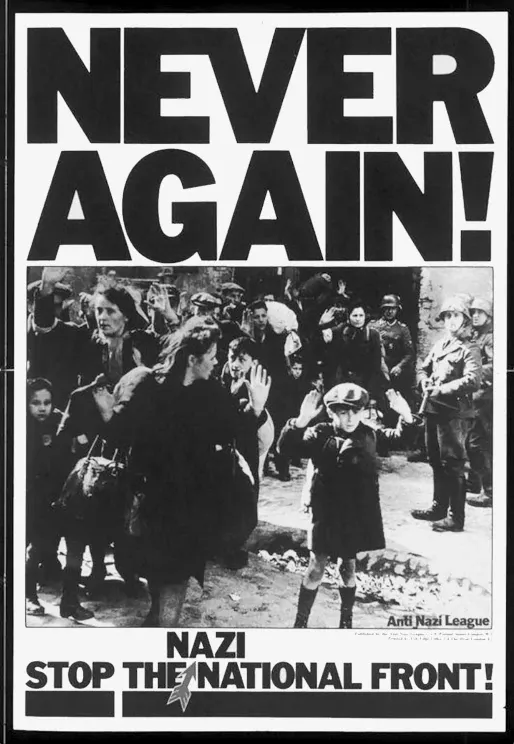
The organisation boasted of plans to stand 300 candidates at the eagerly anticipated 1979 general election, a move that significantly raised its public profile. In this context ‘respectable’ was a relative concept.
Many members of the Metropolitan Police were actively hostile toward ethnic minorities. Brown reports that some were in the habit of going to court wearing neckties adorned with symbols boasting of the numbers of Black people they had
arrested.
We also read that the local press was not averse to condoning the far right; this included the Newham Recorder, whose editor refused to print an anti-racist petition signed by 1,000 teachers, and the Hackney Gazette, which willingly accepted ads from the NF against the wishes of its reporters, who went out on strike in protest.
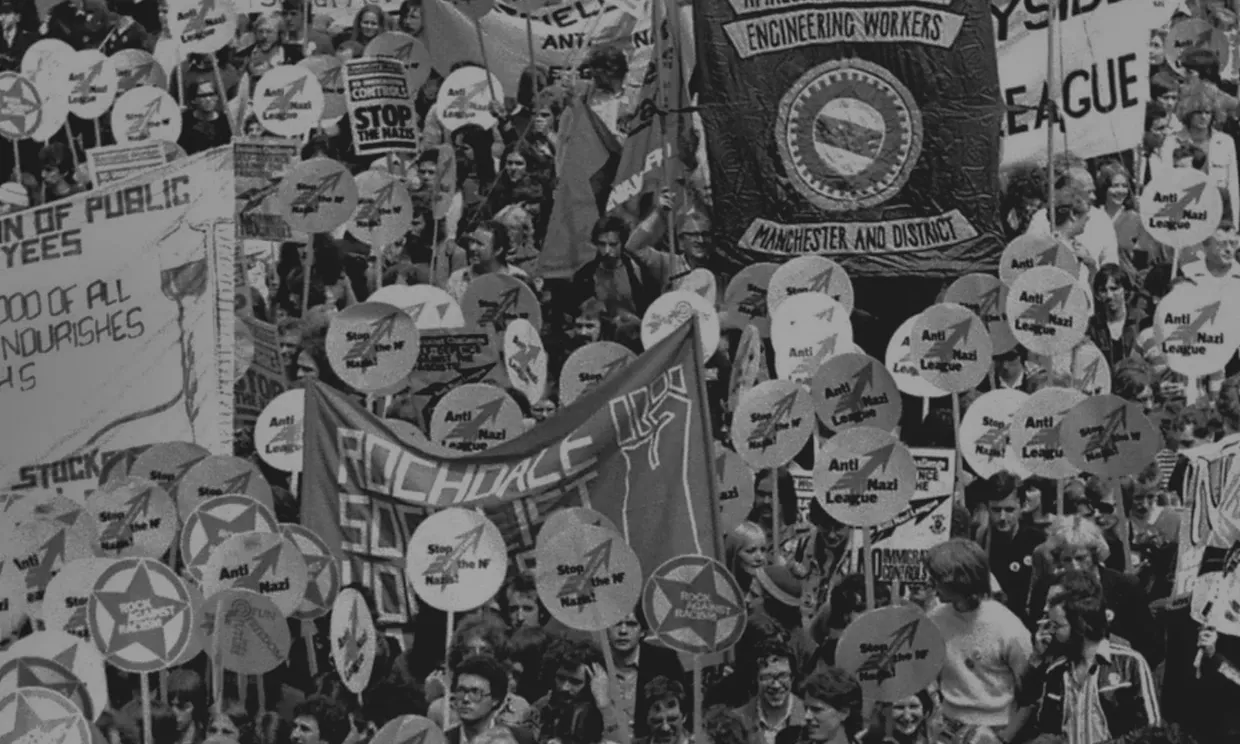
So the left decided to act, and the Anti Nazi League was formed in 1977 by members of the Socialist Workers Party (SWP). Keen to create a broad base, they worked hard to attract adherents from across the political spectrum.
Prominent figures included Labour luminaries such as ANL press officer Peter Hain and soon-to-be leader Neil Kinnock, who chaired the ANL’s first press conference. Liberal MP Richard Wainright also promoted the group, and even the Federation of Conservative Students were briefly affiliates.
More surprisingly still for those familiar with the internecine wars of the far
left was the support of the Communist Party, arch-rivals of the SWP.
Over the course of the next few years, the ANL rapidly grew into more than just an organisation; it spawned a subculture grounded in an ecosystem of associated groups such as School Kids against Racism (SKAN), Council Workers against Nazis (CWAN), Women against Racism and Fascism (WARF), and All London Teachers against Racism and Fascism (ALTARF).
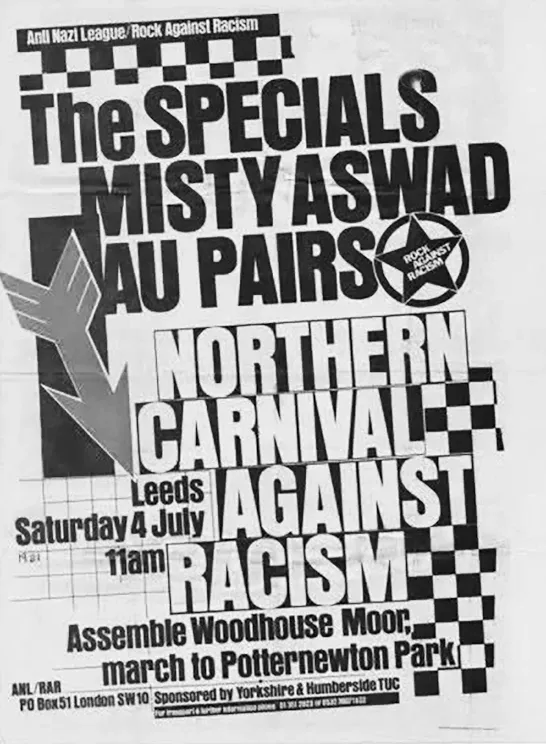
Celebrities from the arts were crucial to the movement’s success, which was able to draw on the support of writer Margaret Drabble, actress Glenda Jackson and poet Benjamin Zephaniah, among others. Perhaps their crowning cultural achievement was the establishment of Rock against Racism (RaR), which organised numerous musical events featuring high-profile acts such as The Clash, Elvis Costello and The Specials.
In making anti-racism cool, RAR was able to draw a generation of young people to the cause. East London had long been a hotspot of both fascism and anti-fascism, and with the NF’s headquarters in Excalibur House (73 Great Eastern Street) in Hackney, anti-racist mobilisation was particularly intense in this part of London. But both the NF and the ANL were a national phenomenon.
By 1979, the ANL had 250 branches and an estimated 30,000 members. Brown counters the claim that it was simply an SWP front by pointing out that its steering committee always had more Labour than SWP members, and that Labour benefited more from it in terms of membership than the SWP.
More important than its political lineage is the fact that the ANL was successful at fending off the National Front as a political threat, as even members of that organisation acknowledged. The social and cultural uprising led by the ANL meant that the NF won only 0.6 per cent of the vote in the 1979 general election.
By the time of the 1983 general election, their vote share had dropped to a
derisory 0.1 per cent. Success lay in organisation and numbers; whenever the NF held a march, rally or other event, the ANL was there in force, outnumbering them and outmanoeuvring them.
Though they eventually disbanded in 1981 when they reckoned their goal had been accomplished, the legacy of the strategies they developed lives on in groups such as Unite against Fascism and Stand up to Racism.
A People’s History of the Anti Nazi League is a meticulously-researched history based on dozens of interviews and analysis of archival sources, complete with 110 pages of endnotes and an extensive bibliography.
We are treated to a selection of original photos and dozens of quotes from those who took part in the movement, making this a true ‘bottom up’ account of a seminal group and a fascinating snapshot of a key moment in the late 20th century with valuable lessons for the present day.
A People’s History of the Anti Nazi League (1977-1981) by Geoff Brown is published by Bookmark.
ISBN: 978-1-917020237. RRP: £12.


