

“When I learned that 96 per cent of Black British adults don’t swim I was shocked, but also I wasn’t, because when I think of that statistic, I think of my mum,” says artist Phoebe Boswell.
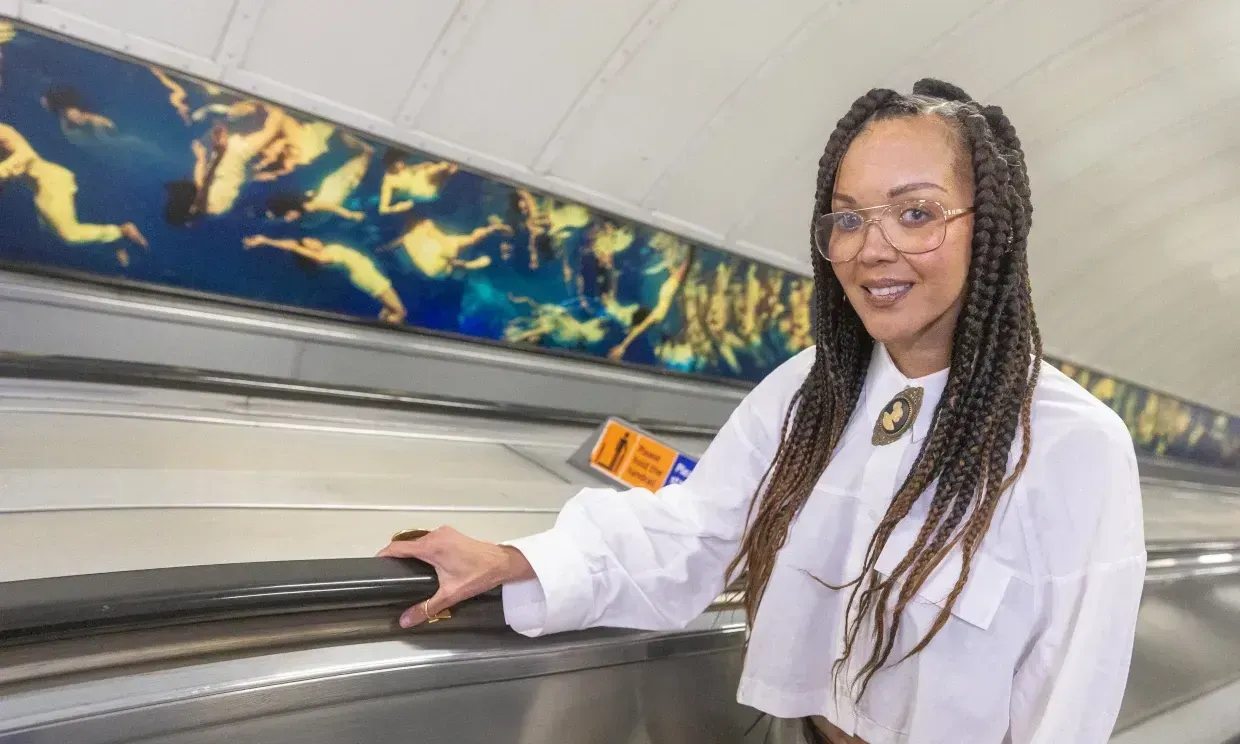
The sobering stat, highlighted by the Black Swimming Association, was the starting point for Boswell’s recently unveiled artwork we move through scales of blue, a new commission for Art on the Underground, that can be seen at Bethnal Green and Notting Hill Gate stations.
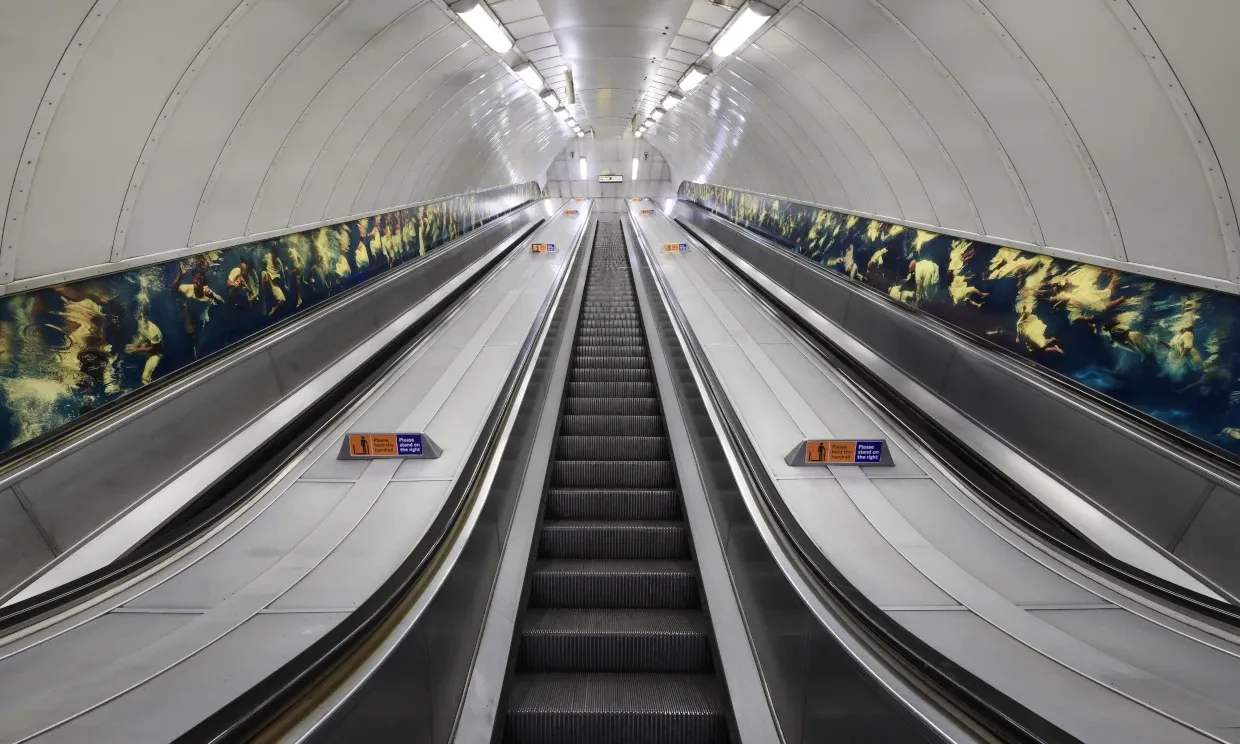
The striking new works feature multi-layered photographic tableaus of Black swimmers who have made London their home, while also reflecting on bodies of water as sites of painful historical experience but also renewal and hope. Dynamic, fluid and almost ethereal, the overlaid figures almost dance their way up and down the escalators.
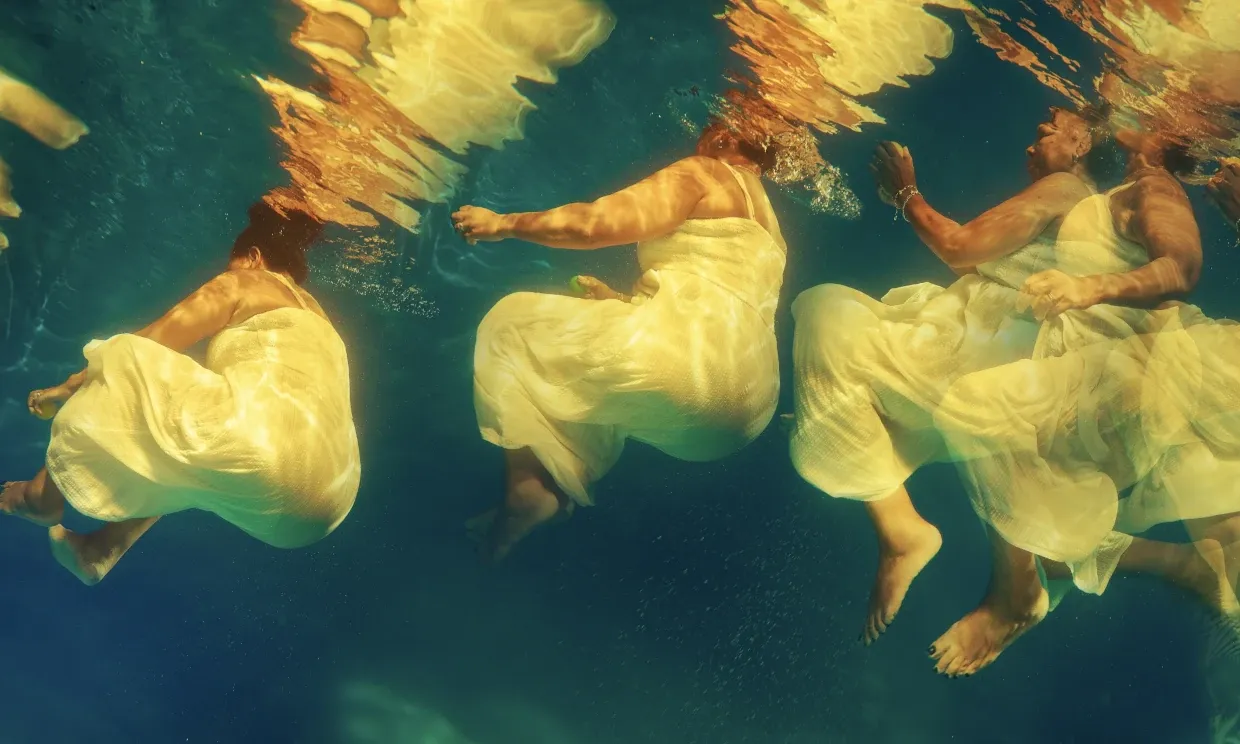
Phoebe-Boswell. we-move-through-scales-of-blue 2026 Commissioned-by-Art-on-the-Underground. Photograph: Thierry Bal
Boswell’s visual approach grew from an ongoing fascination with “water, bodies of water, and bodies in water.” When the Underground sites were proposed, she immediately saw a connection between “the flow and movement of commuters” and “the flow and migrations of bodies in water.” Drawing on her background in animation, she created sequences of still images that give the illusion of movement. “I wanted the bodies of those I chose to participate - individuals from Black swimming communities with a strong affinity to the water - to echo the journeys of the commuters. The process of witnessing that took place with each participant in the underwater studio, followed by the more private, labour intensive, poetic, intuitive process of layering, was the most incredible blessing.”
For the callout to local swimming communities, participants brought their own relationships with water, from memories of migration to moments of refuge and belonging. “What is always striking to me whenever I do participatory work is that every story is unique, nuanced and powerful, and also shared and interconnected,” Phoebe recalls.
“Norma talked about being exiled from South Africa and the long sea voyage here by boat, while Hani spoke about this little boat he returns to in his dreams which makes him feel safe. Lewis spoke about the space between here and Jamaica and how he lives in the belief that the whole world is our home. So many participants described the soft freedom of floating…”
The title itself is beautifully melodic. “I love titles, I find them - and the process of their genesis - so alchemic and enigmatic,” Boswell says of the naming of the artwork. “You want it to play with the work, not speak for it. It can take a while to reach a title, and this was no exception!” The title draws on some of the artwork’s wider references. “The colour blue is citational in Black feminist literature, art, theory, and music, from Dionne brand’s The Blue Clerk to Toni Morrison’s The Bluest Eye, to the blues. While contemplating, I became fascinated by the blue note, or blue scale, in music; its resonances and dissonances.”
She continues: “Scales also obviously have connotations of steplike ascension, much like the escalators I was making the work for. I began with “we” as I wanted there to be a sense of the collective - this work is for you, for us, if you wish it to be - and “we move” spoke to a sense of pushing through, which I am feeling deeply right now, given the state of the world. Despite it all, in spite of it all, we move.”
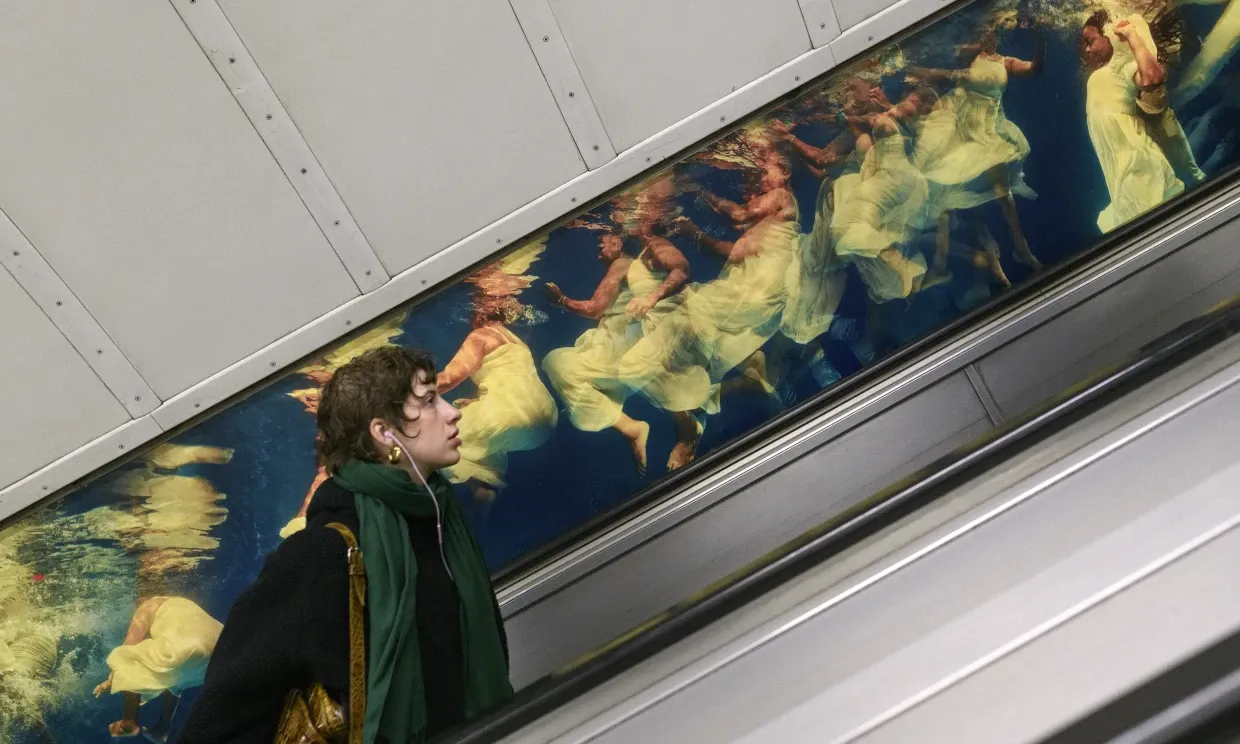
Presenting her work in a space that people move through quickly, rather than a traditional gallery setting, was an “exciting and liberating proposition, but also a responsibility,” Boswell says. “There has to be a care to it because you are becoming part of someone’s day without their consent - unlike a gallery which one chooses to enter.” She continues: “I wanted to speak directly to the site and its parameters. I wanted to provoke reflection. I wanted to promote pause or ease or breath along someone’s day. I wanted to speak directly to you and to all of us.”
Boswell’s work is also rooted in a personal relationship with water. She recalls childhood memories of swimming in Malindi, Kenya. “I remember playing and floating and somersaulting with my sister in the calm ocean water at low tide, and then the rush of fear and exhilaration of nearly being overpowered by the waves once the tides turned. I remember being so conscious of the reckless power of the Indian Ocean, and also the comfort of its holding.” Her mother now lives by the sea in Zanzibar, but does not swim. “Every time I go to visit her, we do this ritual where I try to teach her to float, but she remains adamant that she cannot,” Boswell says. “So when I think of that stat, I think of my mum.”
These encounters with water have shaped Boswell’s ongoing practice of reclaiming water as a space of belonging for Black diasporic communities. “I am drawn to the liminality and dichotomies of water,” she says of this exploration. “The liberating geographical inbetween, where manmade notions of citizenship and rights (that determine who gets to belong and who does not) might cease to exist can be simultaneously reckless and caressing,” whilst also holding “historical legacies of trauma and the promise of a future elsewhere.” Water is also a carrier of memory, Boswell explains: “Water holds memory in the way we think of fossils,” pointing to the vast histories contained within it. “Those who were thrown off slave ships en route to America are still in the water that moves through us.”
Reflecting on the Black Swimming Association’s statistic that 96 per cent of Black British people don’t swim, Boswell speaks of the “ancestral, inherent or inherited tensions and connections to water that sit inside our bodies, owing to legacies of migrations both forced and otherwise.” She also highlights the racial barriers that affect access to swimming, including the “racist fallacy” that Black bodies are less buoyant - a myth that has stopped many people from learning to swim.
Yet we move through scales of blue ultimately looks beyond these barriers, imagining water as a place of “resistance, joy, remembrance and possibility” and a space where new relationships with water can emerge.
we move through scales of blue can be seen at the escalators of Bethnal Green and Notting Hill Gate stations. On display until Spring 2028.


