

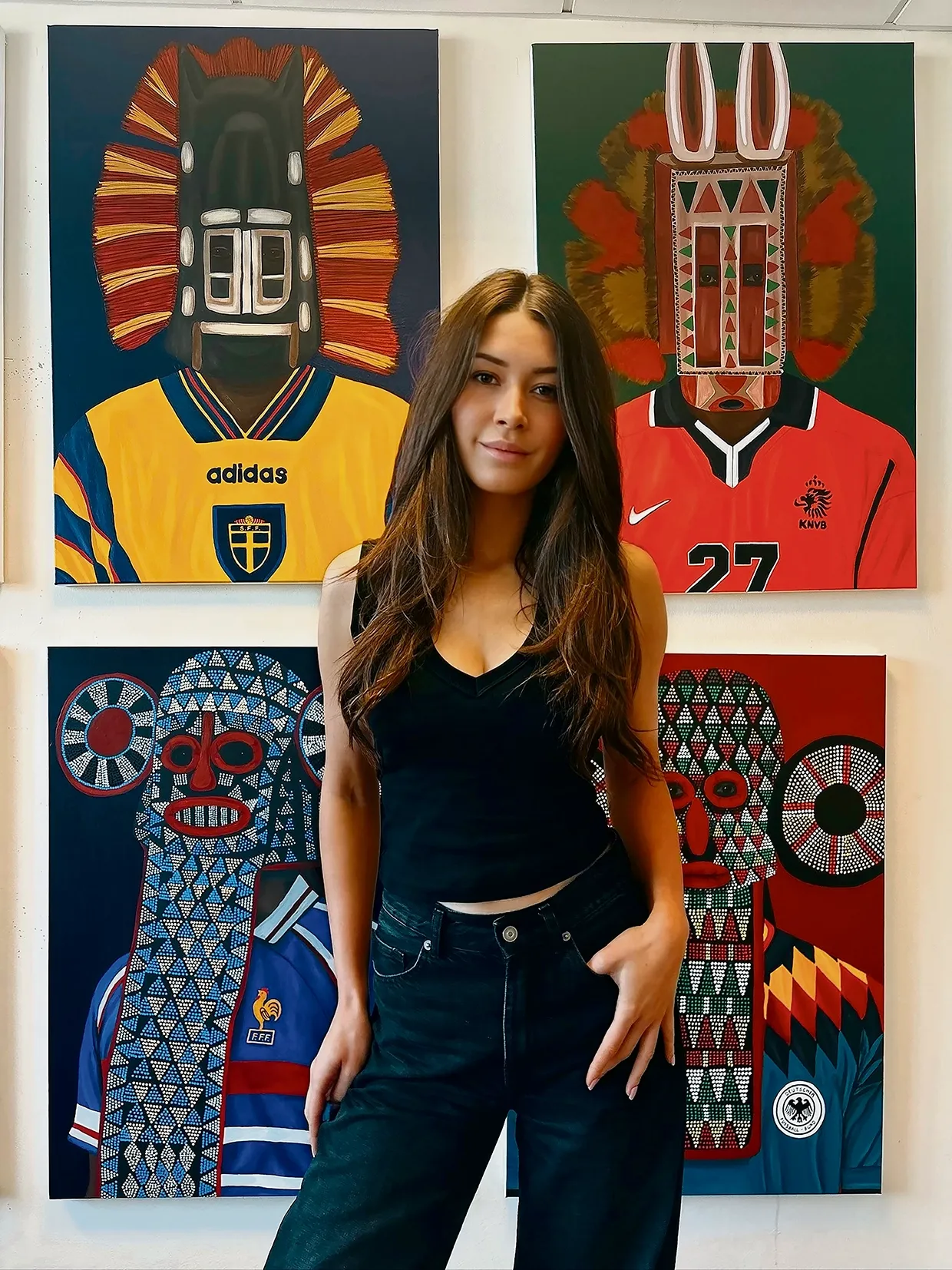
"Migration, travel and cultural exchange have shaped many people's lives, and football is increasingly reflecting that reality", says artist Jil Mandeng, whose new exhibition arrives amid World Cup fever. Coinciding with the knockout stages of the FIFA World Cup 2026, the aptly named Offside? explores the relationship between cultural identity and national allegiance through a series of bold, figurative portraits combining football shirts and masks.
For lifelong football fan Mandeng, the idea for Offside? began with the gap between football's simple visual language and the more complicated realities of identity. "Growing up, I was always fascinated by international tournaments because they present identity in such a clear visual way – every player wears one shirt, represents one nation and stands behind one flag".
Yet the reality is often more complex, she explains to East End Review. "Many [players] have parents from different countries, grew up somewhere else entirely, or have strong cultural ties beyond the nation they represent. Some could have chosen to play for multiple countries. The more I followed football, the more I became interested in the gap between those complex personal stories and the simplified visual language of international football. That's really where the exhibition began".
Mandeng notes that her work is not a criticism of football's traditions, but an exploration of the questions they raise. "I don't think football is behind", she says. "International football is built around nations, and that's part of what makes the World Cup so special. There's something powerful about seeing players represent a country and the emotions that come with that".
The complexity, she continues, comes from the fact that people's lives rarely fit into such neat categories. "Someone might feel connected to the country they were born in, the country their parents came from, and the country they grew up in", she says. "Those connections don't necessarily compete with one another – they can all be genuine at the same time". For Mandeng, football simply makes these questions visible.
"Football is one of the few places where those questions become highly visible", she says, "which is partly why I find it such an interesting subject to explore through art. What's interesting is that this feels like the first World Cup where discussions around players' heritage, family backgrounds and dual nationality have become almost as visible as the football itself. Players such as Lamine Yamal, who represents Spain while also honouring his Moroccan and Equatorial Guinean roots, or Kylian Mbappé, who plays for France and has Cameroonian and Algerian heritage, show how layered national identity can be".
For Mandeng, the themes explored in Offside? are deeply personal. "I think my interest in art and my interest in identity developed alongside one another", she says. "I was born in Chile to a Cameroonian and Polish father and a German mother and grew up moving between different countries and cultures. From an early age, I became aware that people's sense of belonging isn't always straightforward, which naturally made me curious about how identity is shaped".
Art became the medium through which Mandeng explored those questions. "It gave me a way to process experiences that were often difficult to articulate and, over time, became the lens through which I understood the world. I eventually studied at Central Saint Martins and later completed my MFA at the Slade School of Fine Art, but the themes I explore today – identity, belonging and cultural heritage – have been with me for as long as I can remember".
Those themes are embodied in the exhibition's central pairing of football shirts and masks. "The football shirt and the mask represent two different forms of belonging", Mandeng says. "The shirt speaks about nationality, allegiance and public identity, while the mask speaks about heritage, ancestry and cultural memory. Bringing them together allows me to explore the relationship between those things without suggesting that one is more important than the other.
"For me, the works aren't about conflict between identities. They're about showing that different parts of ourselves can coexist".
The masks themselves grew out of Mandeng's research into traditional Cameroonian masks and her own family heritage. Over time, that interest expanded to include mask traditions from around the world. "Across different societies, masks can represent ancestry, spirituality, protection, power, status or community identity. What interested me was their ability to communicate something larger than the individual wearing them". she says.
In the paintings, the masks also serve a practical purpose: concealing the face. "By removing specific facial features, the figures become less about a particular person and more about broader ideas of identity, heritage and belonging". she adds. "The viewer is encouraged to focus on the symbols being presented and the relationship between the mask and the football shirt".
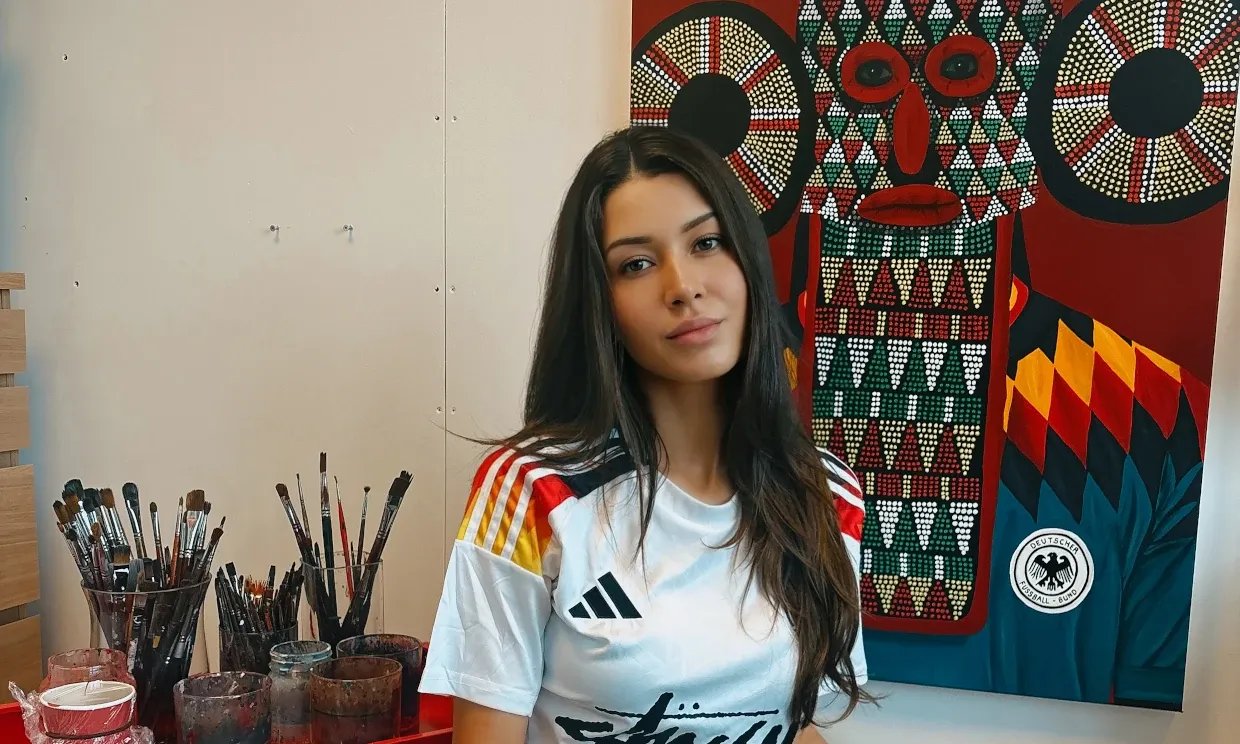
Among the series of works, one piece stands out for Mandeng. "The Cameroon and Germany portrait will probably always be particularly meaningful because it reflects my own family history most directly. It's the piece that feels closest to home and the one that sparked many of the questions that eventually led to the exhibition".
Fittingly, the artist's own World Cup loyalties refuse to fit neatly within a single border. "Cameroon and Poland didn't qualify this year, so I'm supporting Germany and England", she says. "Depending on who you ask, that's either completely reasonable or football treason. Which, in a strange way, is quite fitting for Offside?"
Offside? is on show 2–19 July 2026 at BSMT Space, 529 Kingsland Road E8 4AR.


